

Average Cost of Mobile Bartending Services in 2026
Table of Contents
- What Drives the Average Cost of Mobile Bartending Services
- Hourly Rates vs. Per-Guest Pricing: The Math Behind the Quote
- Mobile Bartending Service Packages: Bartender-Only vs. Full Bar
- Hidden Costs: Insurance, Permits, and Service Fees
- Hiring a Licensed Bartender for Private Parties: What to Verify
- Mobile Bar Setup Requirements That Affect Your Budget
- BYOB vs. Full-Service: Which Model Costs Less?
- Conclusion
- Frequently Asked Questions
Last Updated: October 1, 2026
What Drives the Average Cost of Mobile Bartending Services
The average cost of mobile bartending services depends on four variables: guest count, event duration, service tier, and whether you supply the alcohol. Change any one of those and the quote moves. This guide from Mr. Barrtenderr breaks down how providers build their numbers, so you can compare quotes without guessing.
Guest Count, Event Duration, and Service Tier
Guest count sets the floor. More guests means more bartenders, more glassware, and more alcohol, and most providers staff on a ratio rather than a flat number. Most providers staff on a ratio rather than a flat number. Cross that threshold and you're paying for a second bartender whether you planned to or not.
Location, Season, and Venue Restrictions
Travel distance, peak-season demand, and venue rules all move the number. A venue that requires a licensed, insured vendor, or one that restricts where a bar can be set up, may add setup labor or equipment needs. Saturday evenings in wedding season carry the highest demand.
Hourly Rates vs. Per-Guest Pricing: The Math Behind the Quote
Hourly pricing charges for time; per-guest pricing charges for consumption. The two models diverge sharply as guest count and event length grow, and the only way to know which is cheaper for your event is to run both against your own numbers.
Here is the mechanism behind each model.
- Hourly model: Total = (bartender hours × hourly rate) + add-ons. Setup and breakdown are often billed as separate hours. Overtime typically kicks in after a set threshold.
- Per-guest model: Total = (per-guest rate × guest count) + add-ons. Most providers set a minimum guest count below which the per-guest rate does not apply.
- Hybrid model: Total = base labor fee + (per-guest bar fee × guest count). Common for mid-size weddings where the provider wants to cover fixed labor but still scale with consumption.
How the Math Scales
The table below shows how the same event prices out under each model as guest count and duration change. Rates are illustrative placeholders, substitute your own quotes to see which model wins for your event.
Event Profile |
Hourly Model (labor only) |
Per-Guest Model (bundled) |
Which Wins |
|---|---|---|---|
40 guests, 3 hours |
1 bartender × 3 hrs + setup |
Below minimum, surcharge applies |
Hourly |
75 guests, 4 hours |
1-2 bartenders × 4 hrs |
75 × per-guest rate |
Depends on rate |
150 guests, 5 hours |
3 bartenders × 5 hrs + overtime |
150 × per-guest rate |
Per-guest |
200 guests, 6 hours |
4 bartenders × 6 hrs + overtime |
200 × per-guest rate |
Per-guest |
The Budget-Creep Trap
Per-guest pricing hides labor inside the total, which makes it easy to forget that a second bartender may still be required at higher guest counts. Ask whether the per-guest rate assumes a staffing ratio or whether additional bartenders are billed separately. If they are separate, your "flat" per-guest quote is not flat at all.
Run Your Own Numbers Before You Decide
Take the quotes you have collected and plug them into both formulas using your actual guest count and event duration. If the two totals land within a small margin, choose the model with fewer line items to track. If one model is clearly cheaper, ask the provider whether they will match the other model's structure, many will, because the underlying costs are the same.
Mobile Bartending Service Packages: Bartender-Only vs. Full Bar
Bartender-only service means you hire staff and supply everything else. Full bar service means the provider brings the bar, the tools, the mixers, and often the alcohol. The gap between the two is where most of the cost difference lives.
What a Base Package Usually Includes
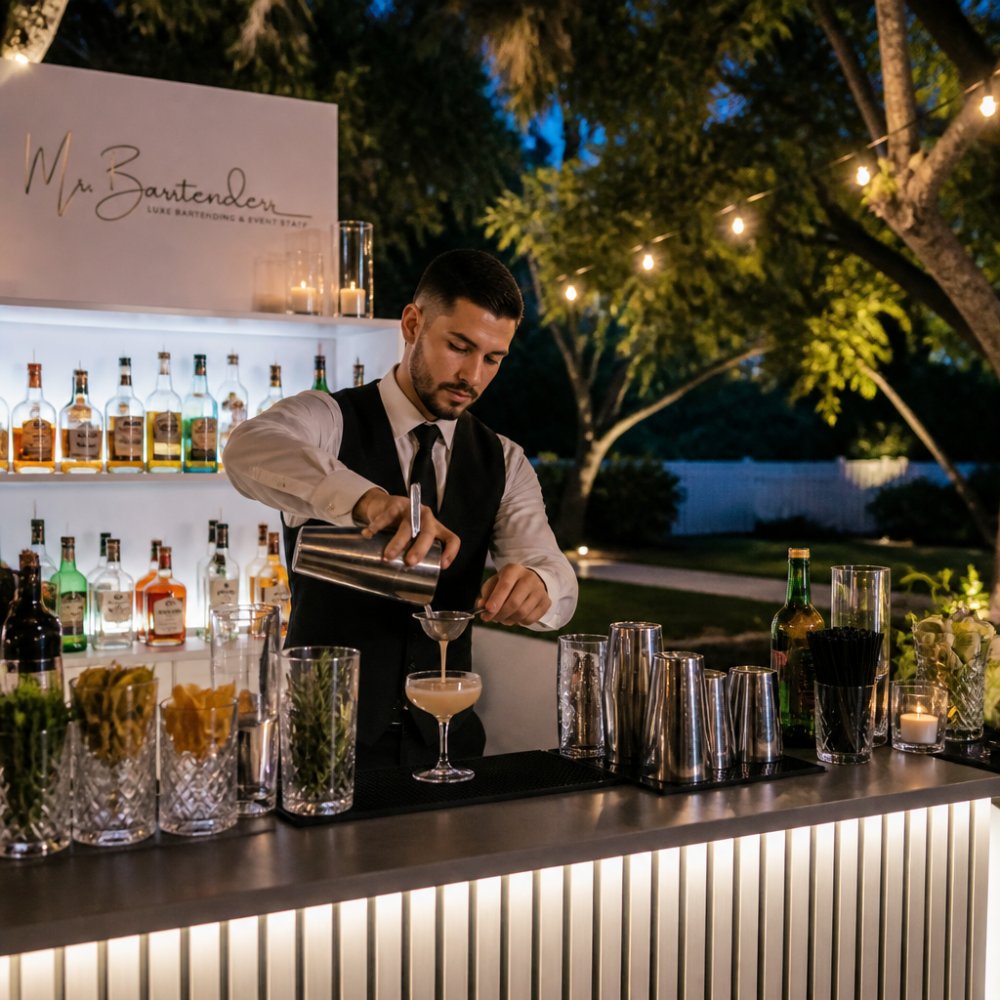
A standard base package typically covers licensed bartenders, a basic bar setup, ice, mixers, and non-alcoholic options. Mr. Barrtenderr's bartender-only option covers professional staff and service, while full bar service adds the complete setup, signature cocktails, and cleanup.
Add-Ons That Change the Total
Add-ons are where budgets quietly grow. Watch for glassware rental, premium spirits upgrades, signature cocktail development, extended hours, and gratuity. Each is legitimate; each adds to the total. Ask for the add-on menu upfront so nothing appears on the final invoice that you didn't approve.
Hidden Costs: Insurance, Permits, and Service Fees
The costs hosts forget are the ones that cause disputes. Liquor liability insurance, permit requirements, service fees, and post-event cleanup rarely appear in the headline rate, yet they are often mandatory. This is the section most pricing guides skip, and it is where budgets actually break.
Who Pays for the Liquor License?
This is the single most misunderstood line item in mobile bartending. In most states, a liquor license is tied to the premises or the event, not to the bartender. That means the responsibility for securing any required permit usually falls on the host or the venue, not the mobile bar vendor.
Liquor Liability Insurance
Liquor liability insurance protects against alcohol-related incidents at your event. Many venues require proof of coverage before a vendor can pour, and a provider without it can leave the host exposed. According to guidance from the U.S. Small Business Administration, businesses serving alcohol carry liability exposure that general policies may not cover.
Service Fees, Gratuity, and Travel
Three line items show up on most final invoices that were not in the headline rate:
- Service fee: A percentage added to the subtotal, common in catering and event staffing. Ask whether it applies to labor only or to the full invoice including alcohol.
- Gratuity: Sometimes built into the service fee, sometimes added separately. Confirm whether the bartenders receive it or the company retains it.
- Travel: A per-mile or flat trip charge for venues outside the provider's standard radius. Ask for the radius and the rate before you book.
Post-Event Cleanup and Waste Management
Ask three questions before you sign:
- Does the quoted price include breakdown and trash removal?
- Who is responsible for returning rental glassware?
- Does the venue charge a cleaning fee if the bar area is not cleared?
Want a quote that shows every line item upfront? Get a transparent, itemized quote from Mr. Barrtenderr and see exactly what is included before you commit.
Hiring a Licensed Bartender for Private Parties: What to Verify
Hiring a licensed bartender for private parties comes down to three checks: licensing, insurance, and certification. Confirm the provider holds a current license, carries liquor liability coverage, and staffs bartenders with responsible-service training.
- Current business license and, where required, a liquor license
- Certificate of liquor liability insurance with coverage limits
- Responsible-service or bartender certification for staff
- Written contract listing every included item and fee
- Confirmed staffing ratio for your guest count
Mobile Bar Setup Requirements That Affect Your Budget
Mobile bar setup requirements determine how much labor and equipment your event needs. Power access, water, space, and venue rules all shape the final number. A venue with no nearby power may require a generator; a venue with a strict footprint may require a compact bar trailer.
BYOB vs. Full-Service: Which Model Costs Less?
BYOB costs less on paper and more in labor. When you supply the alcohol, you control the spend on spirits but you take on procurement, quantity estimates, returns, and often a separate insurance requirement. Full-service folds all of that into one fee and one point of contact.
Conclusion
The average cost of mobile bartending services resists a single number because guest count, duration, service tier, and venue rules all move it. Get line-item quotes, verify licensing and insurance, and confirm what setup and cleanup actually include before you compare totals.
Frequently Asked Questions
What factors influence the average cost of mobile bartending services?
The biggest drivers are guest count, event duration, and service tier. A bartender-only booking for a small party costs far less than a full bar service with glassware, mixers, and multiple staff. Location, season, venue restrictions, and whether you supply the alcohol also shift the total. Insurance, permits, and gratuity add to the bottom line, so ask for an itemized quote that separates labor, supplies, and fees before you compare providers.
Do mobile bartenders provide their own alcohol?
Some do, many do not. Full bar service packages typically include alcohol procurement, mixers, garnishes, and glassware, which raises the price but removes the logistics from your plate. Bartender-only service usually means you buy the alcohol yourself, which can lower the labor cost but leaves you estimating quantities, chilling, and transporting everything. Confirm which model a provider uses before comparing quotes, because the two are not priced the same way.
What is typically included in a mobile bartending service package?
A standard package usually covers professional staff, a mobile bar setup, basic tools like shakers and jiggers, ice and mixers. Higher tiers add glassware rental, signature cocktail development, premium spirits, and bar trailers with lighting. Some packages bundle setup and breakdown, while others charge separately. Ask exactly what is included and what is billed as an add-on, since those gaps are where budgets quietly grow.
Are gratuities included in the average cost of mobile bartending services?
Usually not. Gratuity and service fees are commonly listed as separate line items, often calculated as a percentage of the total or paid directly to staff on the night. Some contracts build a service charge in and leave the tip to your discretion. Read the quote carefully so you know whether the number you see is the final figure or a base that still has gratuity and fees added on top.