

Licensed Mobile Bartender for Private Parties: 2026 Guide
Table of Contents
- Why a Licensed Mobile Bartender Elevates Private Parties
- Mobile Bartender Insurance Requirements and Licensing
- Full Service Bar Packages for Weddings and Private Events
- How to Calculate Alcohol for a Party
- Staffing Ratios and Equipment for Smooth Service
- Legal Liability and Host Responsibility
- Alcohol Procurement and Sustainable Bar Practices
- Pre-Event Communication Checklist
- Frequently Asked Questions
Last Updated: September 14, 2026
Why a Licensed Mobile Bartender Elevates Private Parties
Hiring a licensed mobile bartender changes the entire feel of an event. Instead of a cooler of beer and a folding table, guests walk up to a polished bar, order a signature cocktail by name, and watch it built in front of them. At Mr. Barrtenderr, we've served more than 2,000 clients across Florida and Georgia, and the pattern is always the same: the bar becomes the room's social center.
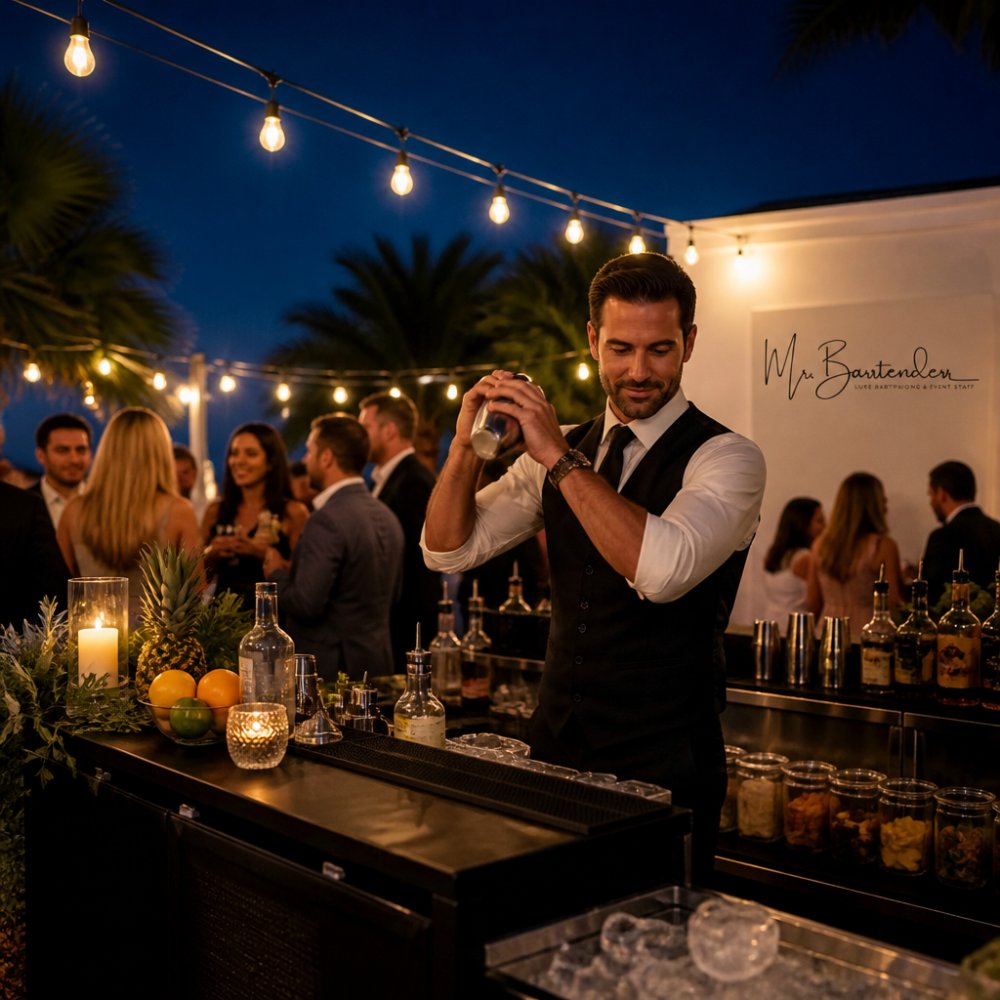
The difference between a licensed mobile bartender and a friend pouring drinks comes down to three things: legal protection, service speed, and consistency. A licensed professional carries insurance and training that protect you if something goes wrong, keeps a line moving, and cuts someone off politely before a problem starts.
Responsible alcohol service is a skill, not a formality, and a trained bartender reads a room in ways a well-meaning friend cannot.
Mobile Bartender Insurance Requirements and Licensing
Insurance and licensing are two different things. A license (or permit) is the legal authorization to serve or sell alcohol; insurance is the financial backstop if something goes wrong. A mobile bartender can be properly licensed and still carry no liability coverage, which is why you ask for both documents before signing anything.
The Two Coverage Types That Matter
Most hosts should expect to see two policies before booking:
- Liquor liability insurance, covers claims tied to alcohol service, including overservice, underage service, and impaired-driving incidents that trace back to your event. Limits commonly start at $1 million per occurrence, though higher limits are available.
- General liability insurance, covers slip-and-falls, property damage, and injuries unrelated to the drinks themselves (a guest tripping over a cooler, a spilled drink ruining a venue floor).
A third policy, workers' compensation, protects you if a bartender is injured on your property. If they arrive with staff, workers' comp should be in place.
How to Verify Coverage Before You Book
Do not accept a verbal assurance. Ask for a certificate of insurance (COI) and read it carefully:
- Confirm the policy is active on your event date, not expired.
- Confirm the limits meet your venue's minimum (many venues require $1 million per occurrence and $2 million aggregate).
- Ask to be listed as an additional insured for the event. This gives you direct rights under the policy if a claim arises.
- Verify the certificate holder matches the business name on your contract.
If a venue requires its own additional-insured endorsement, request it at least two weeks out; insurers can take several business days to issue updated certificates.
Licensing and Responsible-Service Training
Alcohol service is regulated at the state level, and requirements differ for caterers, venues, and mobile bars. Some states require a specific alcohol-service permit; others regulate through the venue's license. A common mistake is assuming the venue's insurance or license covers an outside bartender, in practice, it protects the venue, not your vendor.
Beyond the permit itself, look for TIPS certification or equivalent responsible-alcohol-service training. These programs teach servers to check IDs, recognize overconsumption, document refusals, and de-escalate situations. Ask whether the certification is current and carried on site.
Questions to Ask Before You Sign
- What are your liquor liability limits, and can you add me as an additional insured?
- Are you licensed or permitted for alcohol service in this state?
- Do you carry workers' compensation for staff?
- What responsible-service training do your bartenders hold, and is it current?
- Can you provide a sample COI so I can confirm it meets my venue's requirements?
Getting clear answers to those five questions takes ten minutes and eliminates the most common source of post-event legal exposure. If you want a team that arrives with licensing, insurance, and training already documented, start a booking conversation and we will send the paperwork before you commit.
Full Service Bar Packages for Weddings and Private Events
Full service bar packages for a wedding or private event typically include bartenders, a portable bar setup, mixers, garnishes, ice, and glassware. The exact scope depends on how much you want handled versus managed yourself.
What's Included in a Full-Service Package
A true full-service package removes the bar from your to-do list entirely:
| Service Level | What's Included | Best For |
|---|---|---|
| Bartending only | Licensed bartenders, tools, setup and cleanup | Hosts supplying their own bar and stock |
| Bartenders + bar essentials | Staff plus portable bar, mixers, garnishes, ice | Mid-size parties wanting a polished setup |
| Full bar service | Everything above plus alcohol procurement and custom menu | Weddings and large celebrations |
| Mobile mixology experience | Guided cocktail instruction with full setup | Corporate events and interactive parties |
Mr. Barrtenderr offers flexible service tiers ranging from bartenders-only to complete bar solutions, including wedding bar service built around your signature drinks and mobile mixology experiences where guests build their own cocktails.
How to Calculate Alcohol for a Party
Non-alcoholic drinks matter more than hosts assume; mocktails, dirty sodas, and specialty lemonades keep non-drinkers and designated drivers engaged.
Staffing Ratios and Equipment for Smooth Service
Staffing and equipment are where a bar either flows or stalls. The right ratio depends less on guest count than on what you're pouring, how long the bar is open, and whether guests order in waves.
Staffing Ratios by Menu Complexity
| Menu Type | Guests per Bartender | Notes |
|---|---|---|
| Beer, wine, and simple two-ingredient drinks | 75 | Fastest pours; line moves quickly |
| Standard mixed drinks and a signature cocktail | 50-60 | Most common private-party setup |
| Craft cocktails with shaking, muddling, or fresh citrus | 35-40 | Each drink takes 2-3x longer to build |
| Guided mixology experience | 25-30 | Guests build their own drinks; staff coach and reset stations |
Add a bar back once you cross roughly 100 guests or serve anything beyond beer and wine. A bar back restocks ice, liquor, glassware, and garnishes so bartenders never leave the well.
Equipment Checklist by Service Level
Equipment needs scale with the menu. At minimum, expect:
- Bar structure, portable bar or counter with enough surface for two working stations
- Cold storage, ice bin or cooler sized for 1.5-2 pounds of ice per guest
- Tools, shakers, jiggers, strainers, mixing glasses, bar spoons, cutting boards, garnish trays, and a speed pourer set
- Glassware, reusable glassware for events over 50 guests; disposables only when venue rules or remote locations require them
- Power and water, access to at least one standard outlet within cord reach, and a water source or jugged water for rinsing and batching
- Lighting, a small bar lamp or LED strip so bartenders can read labels and measure pours after dark
Signature drinks with fresh citrus, muddled herbs, or egg white need more prep space and time per drink, plan for a larger back bar and extra prep time before service.
Setup Timeline and Space Planning
Confirm load-in access, elevator or ramp availability, and any venue setup-hour restrictions.
A cramped bar slows service no matter how many staff you hire.
If you would rather hand off the staffing math and equipment logistics entirely, full bar service includes the bar, the tools, the ice, and the team sized to your guest count. Tell us your headcount and menu, and we will build the staffing plan for you.
Legal Liability and Host Responsibility
Host responsibility is the legal reality that whoever serves alcohol can be held accountable for what happens afterward. Many states have dram shop laws letting injured parties pursue claims against a server or host who provided alcohol to someone visibly intoxicated or underage.
This is where licensing stops being paperwork and starts being protection. A licensed mobile bartender carries insurance, follows ID-check protocols, and documents service decisions, documentation and coverage that matter enormously if an incident follows.
Trained bartenders follow guidance on responsible beverage service, including monitoring pace, offering food and water, and arranging safe transport when needed.
Alcohol Procurement and Sustainable Bar Practices
Alcohol procurement logistics are where most hosts underestimate the work: someone has to buy the liquor, transport it, keep it cold, and account for what's opened versus returned. Full-service packages handle this, but if you're supplying your own stock, build a purchase list from your drink menu and buy from a retailer with a return policy on unopened bottles.
Sustainability is the angle most guides skip. Reusable glassware beats disposable plastic on cost and waste for events over 50 guests. Local citrus and herbs cut packaging waste, and batching cocktails reduces bottle waste and per-drink prep time.
A simple sustainable bar setup includes:
- Reusable glassware and metal straws instead of single-use plastic
- Batching signature cocktails to reduce individual bottle waste
- Local, seasonal garnishes rather than imported out-of-season fruit
- Clearly labeled water stations to reduce bottled water consumption
Pre-Event Communication Checklist
A written pre-event checklist prevents almost every problem that surfaces on event day. Send it to your bartender at least two weeks out, and confirm again 48 hours before.
- Final guest count and any expected late arrivals
- Event start time, service start time, and last call time
- Confirmed drink menu, including non-alcoholic options
- Alcohol supply plan: who is buying, who is transporting, who stores it
- Bar location, power access, and water access on site
- Venue requirements, including insurance certificate requests and load-in windows
- Staffing count agreed and arrival time for setup
- Gratuity policy and payment terms confirmed in the service contract
- Emergency contact for the host and the venue manager
- Plan for leftover alcohol and equipment pickup
Mr. Barrtenderr builds this communication into every booking, so hosts know exactly what to expect before the first guest arrives.
Planning a private party involves dozens of decisions, and the bar should not be one you lose sleep over. Mr. Barrtenderr handles the licensing, insurance, setup, service, and cleanup so you can stay present with your guests instead of restocking ice. With full bar service, custom signature cocktails, and a team trained in responsible alcohol service, we bring the entire bar experience to your venue. Get started with Mr. Barrtenderr and give your celebration a bar your guests will talk about long after the last toast.
Frequently Asked Questions
How much does it cost to hire a licensed mobile bartender for a private party?
Pricing depends on guest count, service duration, drink menu complexity, and whether you need a dry bar service or full-service setup. Most mobile bartenders charge an hourly rate per bartender or a flat fee for packages, plus the cost of alcohol if they procure it. Some companies require a minimum guest count. For an accurate quote, contact Mr. Barrtenderr directly with your event details.
What insurance should a mobile bartender have?
A licensed mobile bartender should carry general liability insurance and liquor liability insurance to protect against accidents or alcohol-related incidents. Many venues also require a certificate of insurance before allowing service. Ask for proof of coverage and confirm the policy covers private events. Mr. Barrtenderr is fully licensed and insured, giving hosts peace of mind.
How many bartenders do I need for 100 guests?
For a 100-guest party with a custom drink menu, two to three bartenders prevent long lines. If you add a bar back to restock and clean, service stays smooth. Mr. Barrtenderr can recommend staffing based on your guest count and drink selections.
Do mobile bartenders provide alcohol and mixers?
It varies by package. Some mobile bartenders offer full-service packages that include alcohol procurement, mixers, garnishes, and bartending equipment. Others provide a dry bar service where you supply the alcohol and they handle everything else. For weddings, many couples prefer full-service to simplify planning. Discuss your preference with your provider to choose the right option.